 See photos and updates from listings directly in your feed
 Share your favorite listings with friends and family
 Save your search and get new listings directly in your mailbox before everybody else
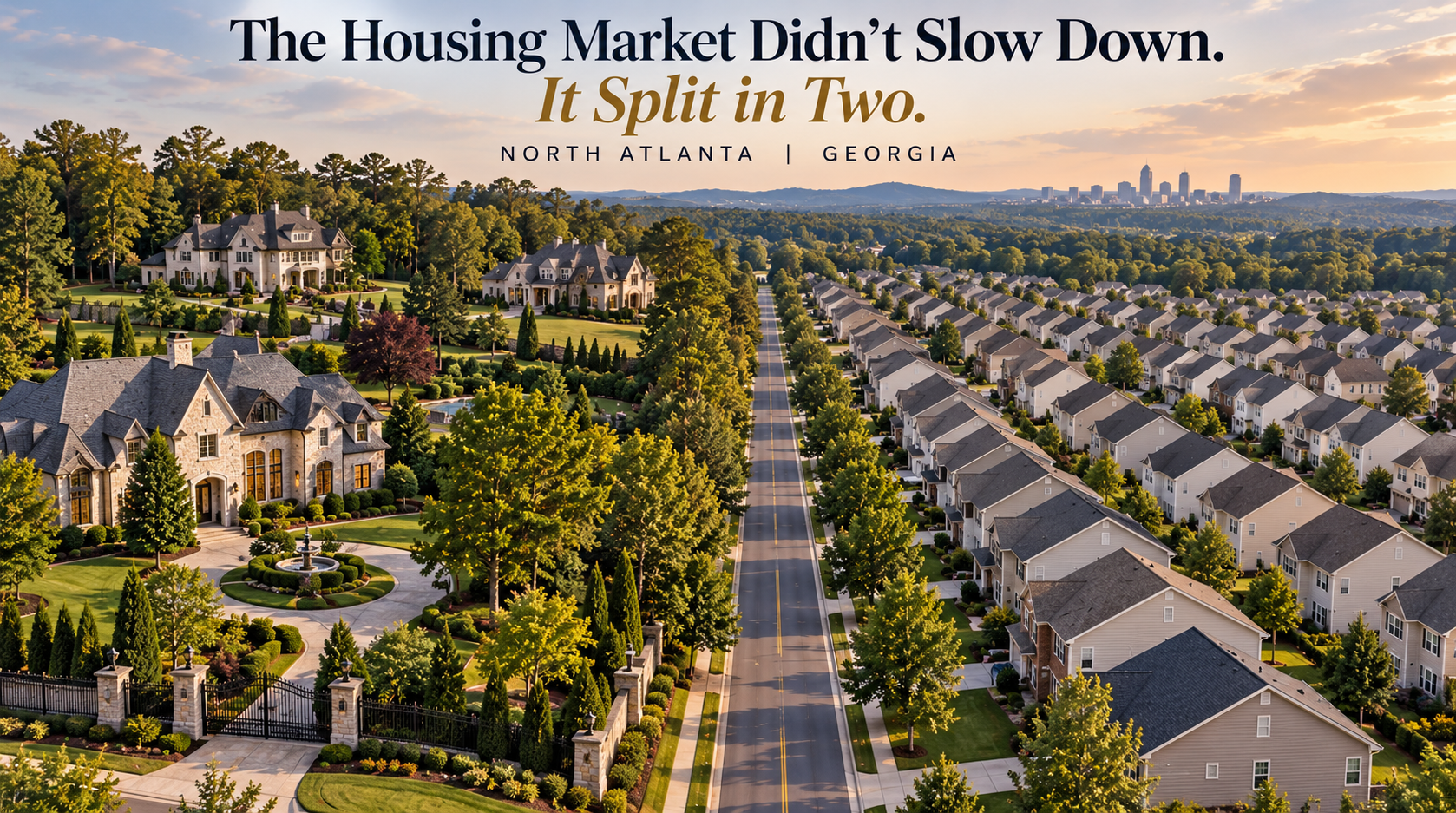
If you are trying to figure out what the housing market is doing right now, the answer depends heavily on which part of the market you are looking at.
Some sellers are dealing with longer days on market, price reductions, and buyers who are increasingly cautious.
At the same time, the luxury market continues to show strength, supported by buyers with significant cash, equity, and investment wealth.
Those two realities may seem contradictory, but they are actually part of the same economic story.
The housing market has become increasingly divided between buyers who are sensitive to borrowing costs and buyers who are not.
A Housing Market Divided by Wealth
We have heard a lot about the “K-shaped economy” over the past several years.
The basic idea is simple: different groups of consumers can experience the same economy very differently.
Higher-income households with substantial investments and assets have benefited from strong financial markets and accumulated wealth. Meanwhile, many middle-income households continue to deal with higher everyday expenses, borrowing costs, insurance premiums, property taxes, and housing payments.
That divide is now becoming increasingly visible in housing.
Luxury home sales have been showing strength while portions of the starter and middle markets have struggled to generate the same level of demand.
And the reason may have less to do with the homes themselves than with how buyers are paying for them.
Mortgage Dependency Is Becoming a Major Dividing Line
Consider two buyers.
One buyer purchases a $500,000 home and needs to finance 80% of the purchase.
Another buyer purchases a $2 million property using cash, investment proceeds, or substantial equity from another property.
They may technically be participating in the same housing market, but economically, they are playing by completely different rules.
For the financed buyer, a mortgage rate in the mid-6% range can dramatically affect purchasing power and the monthly payment.
For a buyer who can purchase primarily or entirely with cash, that mortgage rate may have little influence on the decision.
That is why simply saying “the housing market is slowing” doesn’t tell the whole story.
The better question is:
How dependent is the buyer for this particular property on financing?
That distinction is becoming increasingly important.
The Middle Market Is Feeling the Most Pressure
The most interesting part of today’s market may actually be the middle.
Think roughly $400,000 to $900,000, depending on the local market.
This includes many move-up buyers, growing families, and professionals purchasing their first larger home.
These buyers often earn good incomes, but that doesn’t make them immune to higher borrowing costs.
They still have to make the monthly payment work.
They are also dealing with insurance, taxes, maintenance, childcare, consumer prices, and other expenses that have increased over the past several years.
As a result, these buyers are becoming more selective.
They have more choices.
They are negotiating harder.
And when a property doesn’t make financial sense, they are increasingly willing to walk away.
That is why we are seeing more price adjustments and longer marketing times across portions of the middle market.
It doesn’t necessarily mean something is wrong with those homes.
In many cases, it simply means the seller entered the market expecting yesterday’s buyer while negotiating with today’s buyer.
Meanwhile, Wealth Is Supporting the Luxury Market
The upper end of the market operates differently.
Strong financial markets have helped preserve and, in many cases, increase household wealth among affluent buyers.
That matters because wealth held in stocks, businesses, and existing real estate can eventually become purchasing power.
A buyer sitting on significant investment gains or substantial equity doesn’t necessarily need mortgage rates to fall before making a move.
That helps explain why higher-end real estate can remain active even while mortgage-dependent portions of the market slow.
This is the classic wealth effect showing up in housing.
When asset values remain strong, affluent consumers generally have greater confidence and more capital available for major purchases.
Real estate is one of the places that capital can go.
What This Means for Sellers
For sellers, broad national headlines matter less than understanding the buyer pool for your specific property.
If your home sits in the true luxury segment of your local market, you may be dealing with buyers who have significant cash, investment assets, or equity.
Your strategy should focus heavily on positioning, presentation, marketing, and accurate pricing.
But if your home sits in the middle of the market, you are likely selling to a much more payment-conscious buyer.
That buyer isn’t simply asking:
“Do I like this house?”
They are asking:
“Does this house make financial sense at this price and at today’s payment?”
That changes how a property needs to be positioned.
Sellers cannot automatically price based on what a neighbor received during a different interest-rate environment.
You have to price for the buyer who exists today.
What This Means for Buyers
For financed buyers, there is another side to this story.
Higher mortgage rates have reduced purchasing power, but they have also created negotiating opportunities in parts of the market.
Properties sitting longer can create opportunities for price negotiations, seller concessions, closing-cost assistance, or other favorable terms.
Waiting for the perfect mortgage rate may sound attractive, but rates are only one part of the equation.
If rates eventually decline meaningfully, more buyers could return to the market and competition could increase again.
The better strategy is to understand what you can comfortably afford today and evaluate the entire transaction — purchase price, payment, concessions, competition, and long-term plans — rather than making the decision based on one number.
The Bottom Line
There isn’t one housing market anymore.
There are multiple markets operating at the same time.
At the upper end, cash, equity, investment wealth, and less rate-sensitive buyers are helping support demand.
In the middle, mortgage rates and total ownership costs are putting much more pressure on affordability and purchasing decisions.
That is why one seller can receive strong activity while another seller a few miles away struggles to generate offers.
The difference isn’t necessarily whether the market is “good” or “bad.”
The difference is the buyer.
And in today’s market, understanding who your buyer is — how they finance the purchase, what they can afford, and what alternatives they have — may be just as important as understanding the value of the property itself.